
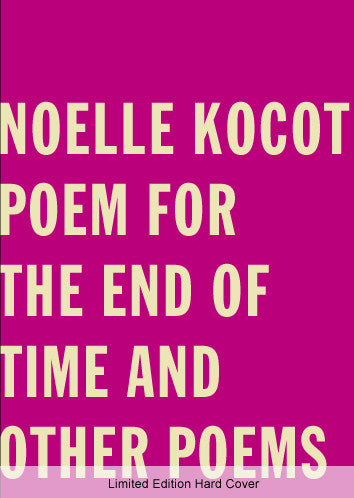
Poem for the End of Time and Other Poems
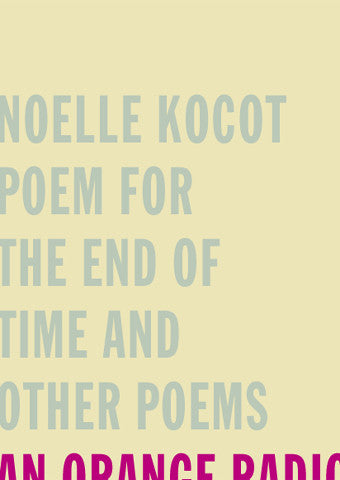
Poem for the End of Time and Other Poems
By Noelle Kocot
-
You leave me no choice my neighborhood
You leave me no choice my neighborhood
Brutal and apocalyptic, a New York epic in the beat tradition. A tragic narrative journey through a New York wasteland and a warning to a city and a world in danger, Noelle Kocot’s third book has the prophetic immediacy of Ginsberg’s “Howl” and the urgent clarity of Langston Hughes. -
In her third book, Kocot (The Raving Fortune, 2004) echoes Ginsberg’s “Howl” in a 33-page elegy on the gentrification and decline of her home borough of Brooklyn, a place which represents both a troubled outer world and a deeply pained inner life in the wake of a husband’s death: "My neighborhood of ghost shoes of Bloomberg and blood.” Sixteen spare and disjointed lyrics also take up these themes, by turns humorous, icy and overwhelmingly sad.
Publishers Weekly
Not for nothing does Kocot’s title summon Beckett’s “I can’t go on, I’ll go on”: these poems are saturated with despair, but cling to a grim, even masochistic hopefulness...Kocot’s ideas are darkly canny and self-reflexive, and she applies tremendous pressure to the music of her lines...
New York Times Book Review
A musical composer is involved in transposition of keys, and Kocot the poet knows the difficulties of translating her love and loss into language that can re-present this emotionally for readers. She insists upon the urgency of her longing for a miracle that would transform or transfigure the “hole” into a “whole.”
Thomas Fink, Octopus Magazine
Her subject matter is emotionally and chronologically close—her obsession is the borough of Brooklyn and the cultural ravages exacted upon it—but she is the arbiter of distances, and an utterly contemporary product of the American culture she indicts. Poem for the End of Time and Other Poems devours any emotional connection to her subject and to the age, as if it is hers alone to devour.
Michelle Lewis, The Gettysburg Review
There’s no denying the courage it takes to write a poem like this, and, more important, the skill and talent necessary to pull it off. Which is all the more reason why Kocot’s work should be read and talked about. Less a “Howl” for the present generation than a “Kaddish,” Kocot’s litany of death and loss—“This furnace of And,” she says in one of the book’s other poems—digs deep into personal and collective grief, where it finds an affirmation laced with a rejection of any easily learned lessons.
Alan Gilbert, The Believer
Kocot takes America and its traditional imagery (apple pie and so on) in order to refashion its contents and to make it begin to signify differently, to resignify. There is a sense of the social and geo-political disturbances of the age unleashed in the opening up of new markets that lead to poetic alterations in the collective identity of the nation and the neighbourhood, the mood and mix of where the poet is. Indeed of the globe itself.
Craig Johnson, Jacket Magazine
Kocot has thought and felt through the language, rhythms and images of the visionary tradition as a way to explore the breakability that connects her fragmenting inner world to a collapsing external order. The speaker is defined by her sense of crisis and by an unbearable emotional pressure. She seems to be under the constant threat of possession, struggling for control against invading forces, and trying to write her way out of it.
Elise Harris, Harp & Altar
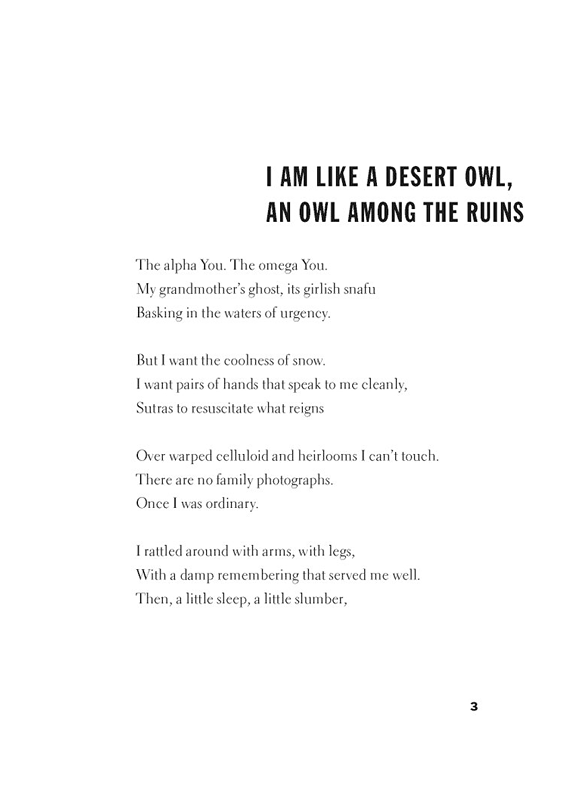
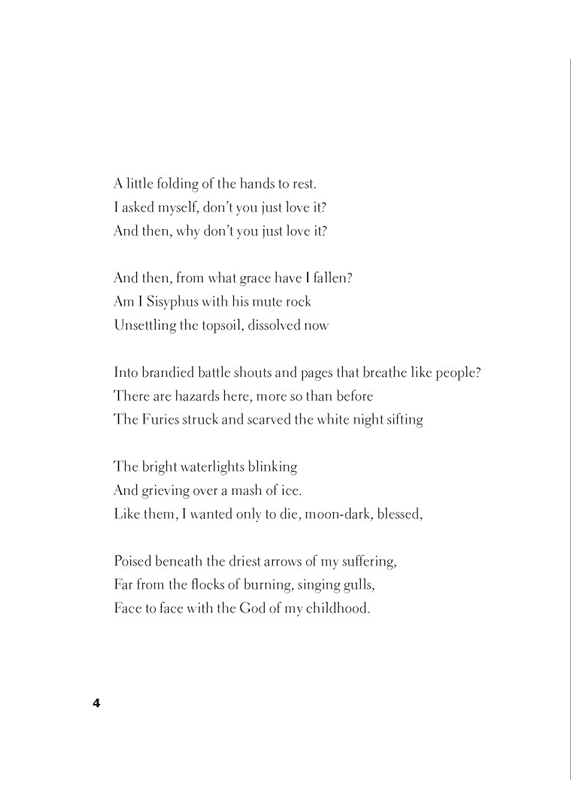
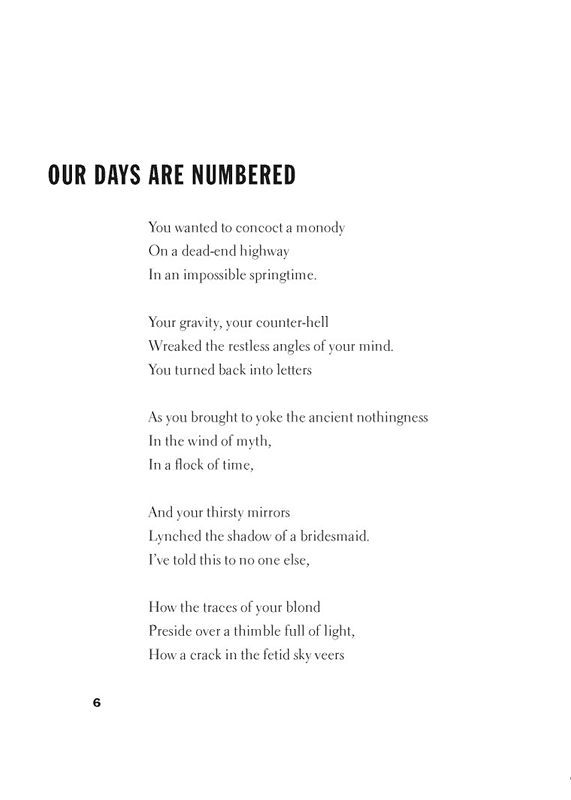
Kocot’s poems are songs rather than stories. Both “Poem for the End of Time” and the wrenching and imagistic short lyrics of the book’s first half risk everything on the hope that a reader will accept their invitation to a heightened emotional state, an invitation that this book’s wit and beauty reward.
Sarah Cohen, Boston Review
Publication Date: April 1, 2006
ISBN# 9781933517018 (5.5x7.25 80pp, paperback)
ISBN# 9781933517059 (5.5x7.25 80pp, limited edition hardcover)
Couldn't load pickup availability
